Please come check it out, and sign up for email delivery of new posts, at:
http://queermomfreespace.wordpress.com/
Wednesday, May 14, 2014

Saturday, March 15, 2014
On Queer Academic Weddings
I really like this post from Madwoman with a Laptop. She's an academic who was opposed to queers gettting married, and still is, pretty much, philosophically. But not in reality. And she tied the knot after 30 years:
Nobody's Wives, Together
Enjoy.
Nobody's Wives, Together
Enjoy.
Wednesday, January 15, 2014
UnWeddings
Check out the article I wrote for for EquallyWed.com: "UnWeddings: Celebrating the Differences Gay Weddings Bring"
 |
| Entering West Hollywood City Hall on our wedding day |
Wednesday, December 11, 2013
A Lesbian Talks Vasectomies
 |
| Jax: Intact and Uncensored (until last Tuesday) |
As a research maven, yet also a typical American who'd always spayed and neutered without a second thought, I went online and found out hormones are good for dogs, and also, that when/whether to spay/neuter is an incredible point of controversy right now in an American dog world in which early spay/neuter is taken for granted as saving millions of unwanted dogs from shelters and euthanasia. I know. I know. Check out Ted Kerasote, Pukka's Promise: The Quest for Longer-Lived Dogs for more. Even the ASPCA, surely the number one advocate of spay/neuter in the country, gives a long list of problems with it--but make sure you read till end of web page, and take the minimizing rhetoric with a grain of salt. Suffice to say the arguments in favor of hormones are--unsurprisingly once you analogize to human beings--strong. So I delayed the Bleu issue but started moving ahead on Jax.
There's just something fishy about a lesbian calling all over creation trying to find someone to give her dog a vasectomy. I felt overly knowledgeable about anatomy I'd previously had absolutely no investment in. Well, other than needing sperm to help us conceive our kids. But even that was a long-distance relationship, so to speak.
It turns out almost no one will give a dog a vasectomy, because it's not taught in vet school, even though it's the simpler procedure. Our long-time practice of three very sweet female vets said "We've never done it" in the kindest way, and left it at that, demurring to call me crazy but completely unwilling to do the vasectomy or a tubal ligation for Bleu, or it seemed, even read the literature I'd brought.
QUICK DEFINITIONS of types of sterilization (with help from Wikipedia):
MALES:
vasectomy: cutting/sealing off tubes "vas deferens" that connect testicles with urethra
neutering (aka castration, as in a gelded horse): the removal of the testes (which produce sperm and 99% of testosterone)
FEMALES:
Tubal ligation: cutting/sealing off fallopian tubes (super rare procedure in dogs)
Ovariectomy: removing the ovaries and not the uterus (rare procedure in dogs)
Typical "spay" is ovariohysterectomy: ovaries, fallopian tubes, and uterus are all removed
Megan didn't know anyone. I called every "surgical specialty" vet hospital in Cincinnati. No dice, though I did get several people who stumbled over the word, or who made me repeat the word, as if they did not hear it often. I checked out the Ohio State Veterinary Medical Center in Columbus. I even called the office of Dr Karen Becker, over in Illinois, because she recommends the procedure on her web site at Mercola. But turns out she doesn't perform it herself. I called the two likeliest candidates up around Chicago because we'd be there over Christmas. No. Further dedicated online searching came up short. Luckily a friend recommended a Cincinnati vet who does conventional but also holistic and complementary medicine. He'd done it once before, four years earlier, on a German shepherd, and was willing to do it again. And the owner of that skimpy record was who we went with.
Talking to friends about it is weird. Especially friends whose husbands have recently had a vasectomy. It somehow gets personal, even though it isn't. What do I know about cutting off balls? What kind of ball-busting dyke am I? Confession: I am the kind who has only fingered balls about twice in my life. It's embarrassing to realize that it 1) took till I'm 52 to actually own a male dog, and 2) took till four days ago till I first compared a dog with balls cut off with my own dog's balls--wow, really makes all those "you've got no balls/you're sure ballsy" metaphors much more vivid.
Or, even weirder--what do I know about not cutting them off? Why do I presumably have more love for testes than straight friends whose dogs are neutered? It's kind of unnatural.
A sad part of all this is my old sweet cocker spaniel, Moosli, who died two years ago, and was of course spayed at a young age without a second thought on my part, had urinary incontinence, weight gain, and two (!) CCL injuries, the second of which directly led to my having to put her to sleep. As ASPCA says, "Dogs spayed prior to five months of age may be slightly more likely to develop ... cranial cruciate ligament (CCL) rupture"--and urinary incontinence, and weight gain.
So last Tuesday I to to the vet's to pick Jax up after his surgery. He's just fine, at my feet, though still is acting pretty drunk with hindquarters not moving properly, and I'd been nervous because it was still surgery after all so I'm a little extra exuberant, perhaps. The vet is male, kind, helpful, sincere, and by all clues heterosexual. I've got a lot of new-found web-based knowledge about male dog anatomy, but I'm still not sure of everything, so in the course of conversation, naturally I think, I ask the expert: "So if the tubes are cut, then where does the sperm that's still being produced in the testicle go?"
He looks embarrassed, I remember it's a waiting room and there's someone and their dog waiting, and the woman at the front desk is sitting close to us as we stand. But I am eager, I am learning, and my dog's fine, really fine, after surgery! "...Oh, well it must be reabsorbed, sperm would have to be if it's not ejaculated, even if the tubes weren't cut" I continue, following my own line of thought and realizing I'm pretty sure Jax has never ejaculated, and he's fine.
Though he is a tall man, the vet's head now tilts down, and his face is redder than before. "I don't know," he says, "I don't know what happens to the sperm." He does a sort of half-shrug and looks away, seemingly despite himself and his desire to answer all a client's questions.
He doesn't know? Seriously?
It occurs to me that perhaps this very nice man before me has had a vasectomy. And I am a dyke treading on possibly thin ice, in alien waters, surely loving my dog, but perhaps overly enthusiastic, a neophyte about these things that straight people, and their pets, apparently work out more silently. Jax and I cut our losses and head happily for the car, both with infertility issues, both with hormones intact. Though I have to carry all 40-some pounds of him because he wouldn't walk, just kept falling down and licking his balls.
Sunday, December 8, 2013
Why Did I Never See Before...
A long Sunday of Ry alternately longing for me then rejecting me. As in "Mommy go away we want to put up the tree without you."
She ran upstairs sobbing and refused to come down for lunch. Then finally at lunch she kept asking if I liked the candle she got for me at Holiday Faire more than the candle that Dylan got for Mama. "Yes honey I love it."
It was like that all day. Why did I never see before that kids has "ID" at the very center of the word?
She ran upstairs sobbing and refused to come down for lunch. Then finally at lunch she kept asking if I liked the candle she got for me at Holiday Faire more than the candle that Dylan got for Mama. "Yes honey I love it."
It was like that all day. Why did I never see before that kids has "ID" at the very center of the word?
Wednesday, December 4, 2013
Photo: Mother and Child, Version 2
Mellower, less fierce but still beautiful echo/reiteration/follow-up to the Catherine Opie photo
from the great blog, 4realequalityweddings.com
my favorite is this one:

Here's a (bad) copy of the Catherine Opie photo, that I discuss in my post
"Fierce and Maternal and Gay" from June 3, 2008

from the great blog, 4realequalityweddings.com
my favorite is this one:

Here's a (bad) copy of the Catherine Opie photo, that I discuss in my post
"Fierce and Maternal and Gay" from June 3, 2008

Monday, November 25, 2013
Government's Most Radical Act of 2013:
Healthcare.gov phone advisor:
"You should put her down as your wife."
"You should put her down as your wife."
Why Does Legally Recognized Marriage Matter So Painfully Much?
Just called HealthCare.gov, trying to get a sane amount of health care at a sane price for our family. Reached someone right away.
"Hi I'm just trying to fill out your form online and it offers a choice 'spouse' or 'domestic partner.' Now Ohio doesn't recognize our marriage but my partner and I are legally married in California--which should I put down?"
"Well would you benefit from some state assistance, like Medicare?"
"No, no. I'm just trying to fill out the form correctly, to get the insurance. And I'm worried because on the Federal level we are filing as spouses, but for the first time, in 2014."
"Well we follow the federal law, so you should put her down as your wife."
"....okay..."
"Is there anything else I can help you with?"
"No. Thanks," choked out, speaking fast, unable to stop my tears.
I hang up too quickly, just as she is finishing. She is cheerful, probably white, young, chatty, a kind voice. "Great. Well if there's nothing else I can help you with, then have a great..." Day.
It is a great day. But I am still crying and I don't know how to make you understand the power of the acknowledgement. I've spent most of my life fiercely not caring about what others think of my sexual orientation and choice of partner. Defensive, yes, but with reason. I have the right, and the need, to defend. To protect my family. It's like crying after you've won the prize, after you've won.
"Hi I'm just trying to fill out your form online and it offers a choice 'spouse' or 'domestic partner.' Now Ohio doesn't recognize our marriage but my partner and I are legally married in California--which should I put down?"
"Well would you benefit from some state assistance, like Medicare?"
"No, no. I'm just trying to fill out the form correctly, to get the insurance. And I'm worried because on the Federal level we are filing as spouses, but for the first time, in 2014."
"Well we follow the federal law, so you should put her down as your wife."
"....okay..."
"Is there anything else I can help you with?"
"No. Thanks," choked out, speaking fast, unable to stop my tears.
I hang up too quickly, just as she is finishing. She is cheerful, probably white, young, chatty, a kind voice. "Great. Well if there's nothing else I can help you with, then have a great..." Day.
It is a great day. But I am still crying and I don't know how to make you understand the power of the acknowledgement. I've spent most of my life fiercely not caring about what others think of my sexual orientation and choice of partner. Defensive, yes, but with reason. I have the right, and the need, to defend. To protect my family. It's like crying after you've won the prize, after you've won.
Monday, June 10, 2013
Gay Pride Cincinnati June 2013

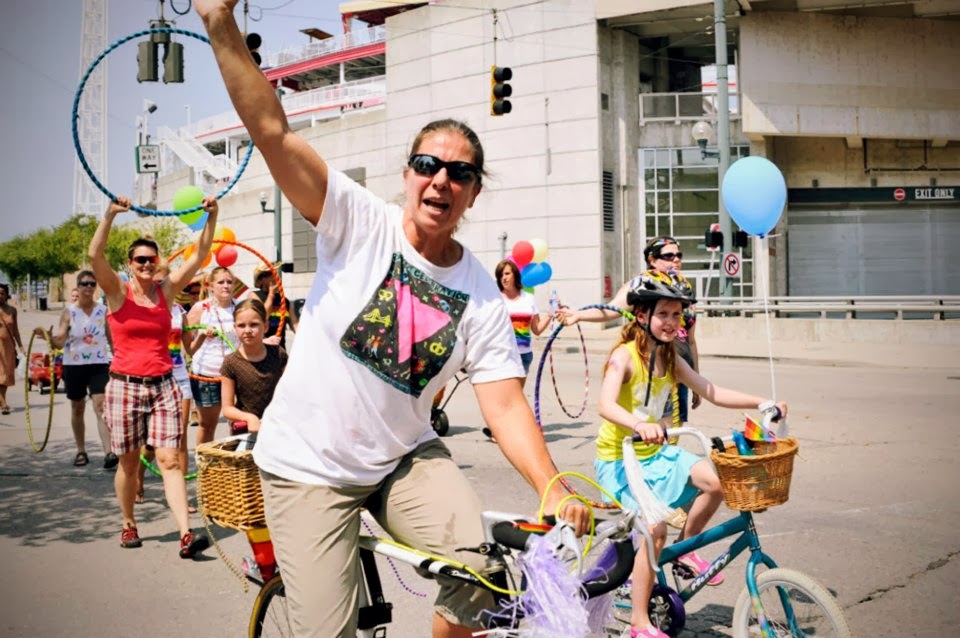
We missed this one, the first we missed since the kids were born. Here the kids are showing off the banner before bringing it over to our friends' house, who went, and rocked it. Rainbow Families Cincinnati ended up winning the award for Cincinnati Pride's 2013 "People's Choice."
Saturday, June 30, 2012


Wednesday, July 20, 2011
More on Michelle and Lucy (see my post here): The Columbus Dispatch quotes Lucy as saying:
In one heart-wrenching recording, confused little Lucy struggles to explain to Hobbs that her ex-partner Mullen no longer wants her to call Hobbs “momma.” Lucy is heard to say, “Mommy says don’t call momma ‘momma’… mommy says ‘momma’s not momma, momma’s Michele’ but I say ‘no mommy, she’s momma.’”
In one heart-wrenching recording, confused little Lucy struggles to explain to Hobbs that her ex-partner Mullen no longer wants her to call Hobbs “momma.” Lucy is heard to say, “Mommy says don’t call momma ‘momma’… mommy says ‘momma’s not momma, momma’s Michele’ but I say ‘no mommy, she’s momma.’”
Tuesday, July 19, 2011
We Live in Fear of Losing Our Kids, Part 2; or: I Meet My Nightmare
Today was Monday, so Susan had the day off. We each did errands in the morning, she got a massage, I took the kids to the doctor, to The Container store to get a thermal yogurt container for Dylan’s new school lunches, and then to Biggs. When we got home at 2 pm, late and hungry, everyone except Susan was grumpy. She fed us, and slowly we recouped. We had to be back home by 5:30, since it was our date night tonight, and we really really needed to talk about money, plus we weren’t getting along too well. It was close to three by the time lunch was over and we almost didn’t go to the pool at all, but once we got in the water I was shocked we’d ever questioned it. Dylan and Rylie were showing Susan all their latest moves they’d just learned in swim class, and were talking over each other in their eagerness to show Susan how they could dive in the five-foot and swim--well they thought, barely I thought--to the rope.
Suddenly I realized that instead of joining us in the water, Susan had sat down close to a woman, two women really, she had nodded at a minute before. But it was clear that one woman was the center, the other lay back, beautiful, blond, and thin, in a black strapless bathing suit, a bit removed under big sunglasses. She looked straight, model-straight. The other one I didn’t immediately recognize, but could tell by the intensity of Susan’s and her exchange, and by the kind, pitying slope of Susan’s back, that it was Michelle Hobbs. (Michelle had just lost custody of her daughter to her former lesbian partner see my post about it from just a few days ago.) We had never seen Michelle at the pool before, didn’t know she’d joined, in fact I hadn’t seen her in years, though Susan, Dylan and Rylie had seen her and her girlfriend when they stopped in at Michelle’s new pet store at Findlay Market to get fresh produce on Sundays. They talked for a long while then when we came out of the water for kids time-out, I tried but couldn’t keep Ry away from the huddle, from Susan, so we all went over, tragedy was only four lounge chairs away. Even though I was wet, I gave her an immediate hug, “You’re Michelle aren’t you. I’m so sorry.”
She acknowledged both things, and we introduced our kids. Soon Susan left, pulled away by Rylie and Dylan. I stayed to talk. Michelle’s ex had won on appeal in the Ohio court, and she had sent out the email from a week ago, asking for any help anyone had to offer, because the ex had denied her the right to see her child ever again, since she was not the bio-mom. They had broken up maybe three years ago, when Lucy was three. She told me about three sets of signed documents she had, listing her as a “complete and full” co-parent in every way. She told me about the judge who’d recused herself without explanation after a year and a half on the case, who’d already ruled once in Michelle’s favor and had found her ex “not a credible witness” as she lied about never having wanted Michelle a co-parent, despite the signed documents and the emails addressed to “Mama” and having her pick the sperm donor and being present throughout the process and at the birth and fully raising the child together for a while. The judge had recused herself and was replaced by a judge who was certainly a friend of her ex’s family, with extensive links, who in two weeks ruled against Michelle and inserted into the record six statements saying that the ex “had never considered Michelle to be a parent at any time” that had no basis in the interviews or other records of the case, but as Michelle sadly but insistently told me (as she told anyone, anyone might be *the* person who could help her) would now be part of the official record.
“It —this whole thing—has really,” she glanced at her girlfriend, trying to mitigate but be honest, “affected our relationship too…” —she gestured with her hands “—see even now hear I am talking about it instead of——”
“It’s okay honey, it’s fine,” says Amanda, still leaning back, not talking but watching both of us, paying attention to the conversation.
“This place,” says Michelle, meaning the swimming pool. “It was a lot, too much, for us to buy the membership really, but we bought it for Lucy. We knew this would be a great place for the summer for her, for us.” She looks right at me, she takes off her sunglasses, and I try to look her in the eyes with care and without crying. “This is where we came, last Sunday, for our last time together. Right here. That”—she points to an elevated porch where we had Dylan’s birthday party last year—is where we are supposed to have Lucy’s birthday party.” I am crying now, tension deep in my throat. Trying to honor her loss with my presence, with my tears, by staying, even though it’s hard. I am a nonbiological mother. I am crying again right now.
Not that breakups happen, but that children lose their mothers entirely, and mothers lose their children, through the homophobia of their partners, through the homophobia of our government.
Suddenly I realized that instead of joining us in the water, Susan had sat down close to a woman, two women really, she had nodded at a minute before. But it was clear that one woman was the center, the other lay back, beautiful, blond, and thin, in a black strapless bathing suit, a bit removed under big sunglasses. She looked straight, model-straight. The other one I didn’t immediately recognize, but could tell by the intensity of Susan’s and her exchange, and by the kind, pitying slope of Susan’s back, that it was Michelle Hobbs. (Michelle had just lost custody of her daughter to her former lesbian partner see my post about it from just a few days ago.) We had never seen Michelle at the pool before, didn’t know she’d joined, in fact I hadn’t seen her in years, though Susan, Dylan and Rylie had seen her and her girlfriend when they stopped in at Michelle’s new pet store at Findlay Market to get fresh produce on Sundays. They talked for a long while then when we came out of the water for kids time-out, I tried but couldn’t keep Ry away from the huddle, from Susan, so we all went over, tragedy was only four lounge chairs away. Even though I was wet, I gave her an immediate hug, “You’re Michelle aren’t you. I’m so sorry.”
She acknowledged both things, and we introduced our kids. Soon Susan left, pulled away by Rylie and Dylan. I stayed to talk. Michelle’s ex had won on appeal in the Ohio court, and she had sent out the email from a week ago, asking for any help anyone had to offer, because the ex had denied her the right to see her child ever again, since she was not the bio-mom. They had broken up maybe three years ago, when Lucy was three. She told me about three sets of signed documents she had, listing her as a “complete and full” co-parent in every way. She told me about the judge who’d recused herself without explanation after a year and a half on the case, who’d already ruled once in Michelle’s favor and had found her ex “not a credible witness” as she lied about never having wanted Michelle a co-parent, despite the signed documents and the emails addressed to “Mama” and having her pick the sperm donor and being present throughout the process and at the birth and fully raising the child together for a while. The judge had recused herself and was replaced by a judge who was certainly a friend of her ex’s family, with extensive links, who in two weeks ruled against Michelle and inserted into the record six statements saying that the ex “had never considered Michelle to be a parent at any time” that had no basis in the interviews or other records of the case, but as Michelle sadly but insistently told me (as she told anyone, anyone might be *the* person who could help her) would now be part of the official record.
“It —this whole thing—has really,” she glanced at her girlfriend, trying to mitigate but be honest, “affected our relationship too…” —she gestured with her hands “—see even now hear I am talking about it instead of——”
“It’s okay honey, it’s fine,” says Amanda, still leaning back, not talking but watching both of us, paying attention to the conversation.
“This place,” says Michelle, meaning the swimming pool. “It was a lot, too much, for us to buy the membership really, but we bought it for Lucy. We knew this would be a great place for the summer for her, for us.” She looks right at me, she takes off her sunglasses, and I try to look her in the eyes with care and without crying. “This is where we came, last Sunday, for our last time together. Right here. That”—she points to an elevated porch where we had Dylan’s birthday party last year—is where we are supposed to have Lucy’s birthday party.” I am crying now, tension deep in my throat. Trying to honor her loss with my presence, with my tears, by staying, even though it’s hard. I am a nonbiological mother. I am crying again right now.
Not that breakups happen, but that children lose their mothers entirely, and mothers lose their children, through the homophobia of their partners, through the homophobia of our government.
Friday, July 15, 2011
We Live in Fear of Losing Our Kids
I got this email via a friend who is good friends with this mom, who is also an acquaintance of mine, who has lost/is losing her child as a result of the breakup of her relationship to her former partner, the "bio mom."
I had a nightmare about losing the kids the night after reading this.
From: "'Chele"
Date: July 14, 2011 12:29:08 PM EDT
Please read this and forward to anyone you think could help.
I am reaching out to whomever and wherever I can, to try and keep my fight for Lucy alive. Mullen's attorney commented to the press that "this case will be going straight to the US Supreme Court". No one seems to know why he said that, but if there is any way possible that my chance of fighting for Lucy is not over, I want it. I know you are busy, but if you could take the time to read this opinion, and help me uncover the slightest error or words that opens the door for us to at least FILE with the US Supreme court and pray for an audience and most importantly get my visitation reinstated through the process it would be worth the world to me. Even if it took them 2 years to reject it, we could possibly get my visitation returned during the process. Please, please, please...try and find something, anything that would give me some hope. Share this with anyone you can....Lisa Meeks knows I am begging for help...she is still trying to find a way as well. Lucy is going to be 6 years old in two weeks. I do not know which feeling is more powerful right now; the fear and loneliness of never seeing Lucy again, or the anger and outrage I have over a judicial system that could allow a lie to destroy the future of my little girl and me. Go to the link below and click on the slide show (volume on) of the first years of me and Lucy. The song was written by my friends; The Wild Mountain Berrys, it will break your heart. Too often lawyers must put their feelings and emotions aside, but I believe when it comes to family matters, you should do just the opposite. In my situation you are fighting for someone who can't, a little girl who is not allowed to have a voice. NONE. Because I have been denied any rights, Lucy will NEVER be able to speak to what matters to her. I won’t be allowed to reach out to her until she is an adult at 18, and by that time the truth will cause more harm than good I'm afraid. PLEASE try and help. Fresh and eager minds always bring new ideas and hope. Pass this on to colleagues, law students, professors, anyone who might be able to salvage this case…my life and the future of my family. Thank you...with my all my heart....thank you for your help and understanding.
‘Chele & Lucy
Photo show of me and Lucy: www.TruthforLucy.com (you can also view Ohio SUPCO hearing here)
Slip Opinion: http://www.supremecourt.ohio.gov/rod/docs/pdf/0/2011/2011-Ohio-3361.pdf
I still haven't looked at the slideshow. Couldn't bear it.
I had a nightmare about losing the kids the night after reading this.
From: "'Chele"
Date: July 14, 2011 12:29:08 PM EDT
Please read this and forward to anyone you think could help.
I am reaching out to whomever and wherever I can, to try and keep my fight for Lucy alive. Mullen's attorney commented to the press that "this case will be going straight to the US Supreme Court". No one seems to know why he said that, but if there is any way possible that my chance of fighting for Lucy is not over, I want it. I know you are busy, but if you could take the time to read this opinion, and help me uncover the slightest error or words that opens the door for us to at least FILE with the US Supreme court and pray for an audience and most importantly get my visitation reinstated through the process it would be worth the world to me. Even if it took them 2 years to reject it, we could possibly get my visitation returned during the process. Please, please, please...try and find something, anything that would give me some hope. Share this with anyone you can....Lisa Meeks knows I am begging for help...she is still trying to find a way as well. Lucy is going to be 6 years old in two weeks. I do not know which feeling is more powerful right now; the fear and loneliness of never seeing Lucy again, or the anger and outrage I have over a judicial system that could allow a lie to destroy the future of my little girl and me. Go to the link below and click on the slide show (volume on) of the first years of me and Lucy. The song was written by my friends; The Wild Mountain Berrys, it will break your heart. Too often lawyers must put their feelings and emotions aside, but I believe when it comes to family matters, you should do just the opposite. In my situation you are fighting for someone who can't, a little girl who is not allowed to have a voice. NONE. Because I have been denied any rights, Lucy will NEVER be able to speak to what matters to her. I won’t be allowed to reach out to her until she is an adult at 18, and by that time the truth will cause more harm than good I'm afraid. PLEASE try and help. Fresh and eager minds always bring new ideas and hope. Pass this on to colleagues, law students, professors, anyone who might be able to salvage this case…my life and the future of my family. Thank you...with my all my heart....thank you for your help and understanding.
‘Chele & Lucy
Photo show of me and Lucy: www.TruthforLucy.com (you can also view Ohio SUPCO hearing here)
Slip Opinion: http://www.supremecourt.ohio.gov/rod/docs/pdf/0/2011/2011-Ohio-3361.pdf
I still haven't looked at the slideshow. Couldn't bear it.
Wednesday, July 6, 2011




Saturday, June 25, 2011
Santa Cruz Trip
I sit on the plane heading into San Francisco and look out at the snow-blessed mountains and think: am I tainted by now? Am I still as free from homophobia and prejudice as when I left here? The physical traces indicate problems. I shave my legs now, just shaved them last night, at 1:30 in the morning. My hair was short and cute & dykely when I lived here, now is it Cincinnati-fied?—it’s long and thick and held high and back in a ponytail. I have spent over a year depressed about that most heterosexual female obsession, weight loss. Ry has called herself fat many times this year, and Dylan proudly calls herself thin in response. This despite the most feminist household I can conjure. And all those sweet kind Waldorf moms, my real and good friends—I just wish there were also dykes there. I thirst for Santa Cruz and most lesbians I know in Cincinnati don't even know what they are missing.
Monday, June 20, 2011
The Month I Became Straight ...
Yesterday I turned to look at myself and realized I was almost completely utterly a straight woman. In her stereotypical form. I had two kids that I doted on. I was a stay-at-home mom. I had long hair and shaved my legs. Most of my friends, at least those I talked with daily, were straight, having somehow found decent, kind, loving and liberal husbands. My grad school experience had been so the opposite, an immersion in a pro-gay world, with my first ever openly gay professor, who was world-famous at that, world famous due to her brilliance. She invented the term “queer theory” for goddess’s sake. She was hot. Most of my friends were gay or actively pro-gay or more progressive politically than I was. But no more. We’d found a real home in the Waldorf community, an easy way to self-select for liberal allies. It was a wonderful relief to be less pro-biotic, less vegan, and less concerned about some progressive or new age cause than a certain percentage of the population there. It's nice not to be carving out your space every second.
And over the past two years I’d added to my repertoire the kickers, the internal signifiers of heterosexuality: I thought more about fashion than I ever had—though I'd never thought about it a lot. Mostly I thought more about how I dressed, instead of just putting on something comfortable and asexual. And I began to think too much about weight. I’d always been thin, or at least fine, I’d always been athletic and hadn’t thought much more about it. I was happy, satisfied, and didn’t know what all the fuss was about with other girls’ obsessions with weight loss. Then in the two years of trying to get pregnant, of obsession with trying to get pregnant, the books told me weight gain was a good sign. And with my tendency to eat to relieve stress, I gained weight even before I got pregnant with Dylan. Then at my pregnant height I was 208 pounds. And not worried about it. But after a certain number of pounds lost after she was born I couldn’t take any more off.
Who knew? I know that apparently the whole straight white female world knows this, but I didn’t know. My need for relief from stress through chocolate was high, especially when the kids were little. It was hard to work out, hard to find the time for myself. It sounds trite but that’s how it was.
The weird thing is that I felt thinking about weight was a straight girl issue—for me it really was. So that I was somehow giving in, or being traitorous, to care about weight. It was not my conception of dykedom to care about weight. Especially to care about calories. I of course had no money or no desire for Jenny Craig or Weight Watchers—that was beneath the athletic carefree me and not something a self-respecting dyke paid attention to. So when a few months ago I sneaked onto the online site Calorie Counter, and actually found it useful, I felt illicit, and guilty, and … straight. My athleticism and my dykedom have always and are still related for me. I am strong, athletic, like having muscles, dykely. It’s a way of loving myself, my body. I know there are plenty of Olympic athletes who are straight. But there is also Martina Navratilova, and Billy Jean King, two of the earliest celebrities to come out when I was young.
Here I was mired mostly happily in the home, with my 2.3 kids (almost) and my dog (well two) and instead of a white picket fence a dilapidated urban fence with too much glass on the sidewalk. Definitely culturally straight, and straight if you watched me coming into the playground or into the grocery store. I had a silver wedding band on instead of gold one, sure. I had the HRC sticker on my car but so many don’t know what that means. So my reluctance to act ‘straight’ by losing weight—such a girly girl thing—helped make me stuck feeling bad. But I realized I had caught myself on the horns of the dichotomy: If dykedom were defined in opposition to straight girlhood, then the binary oppositions lined up like this:
Gay Straight
_____________________
Casual Dressed up
Athlete wimpy non-muscular girl
No make up makeup
No fashion fashion
Rebellious conforming
Athlete sorority girl
Self-defined societally defined
Self-initiating defined by others (men or peer competition)
But also, to my detriment, like this:
Gay Straight
_______________________________
Fat thin
No kids mom
Works stay at home
Doesn’t care Obsesses about
about appearance appearance
Then I went bra shopping. I don’t know why my mom had failed to give me this experience. Perhaps it was mercy. I only know that bras were something I rarely bought, and rarely thought about, pre-kids. When pregnant my breasts blossomed, and afterwards I nursed for many years, so I knew something about nursing bras. During and after that my breasts stayed huge (for me). And while I realized an undercurrent of dissatisfaction with my bras I was too busy to pay attention. Then Susan had a wedding to go to, and her bootcamp friends decided to help her find a great outfit. All well and good, but then they went bra shopping, and I went along. I mean really went bra shopping, we had the name in hand of the best customer attendant at Nordstroms at the Kenwood Mall, and we went in a group, and I was completely out of my element. I’d gone once before, to a bra fitter at Macy’s when I was pregnant and huge…but that was a focused, desperate experiment and I’d gotten only wire-free bras.
In the end, I went three times before I got one underwire I liked, and spent two months studying the HerRoom site online before buying seven bras from them, all but one of which I returned, an athletic bra without wires. How much work being heterosexual is! I did very much like how my breasts looked supported, having never thought about it that much before, since before my breasts were much smaller or I was nursing. Now I was a double D! I felt that if each article of clothing was going to be two months worth of full time work, then I’d never really become well dressed. Susan’s straight friends, on the other hand, her bootcamp buds, spent all day helping her shop for a little black dress—Susan’s first dress in a very long time—three people shopping a bit for themselves but mainly for the fourth, and coming back successful, only to say: well now it’s time to get a bra, and then shoes, and then accessories. So much work, I found it ridiculous, even as I loved the finished look.
All of which is to say that binary oppositions are best challenged and messed with, as Derrida tells us. But that it was hard in such a straight, conservative location to give up even any signs of gayness. If I’d been in San Francisco or Santa Cruz, where multiple representations of lesbiandom, dykedom, femmedom, queerdom, and bisexuality blossomed, then playing with my self image would not have been so hard. Here I felt less free, less able to enjoy the pleasures of my own possible images, perhaps like some black people who choose not to dress down because they think that it will (and it often does) make whites perceive them more negatively. I often felt invisible, and certainly not affirmed in my gayness,much less my gay momdom. What I would have given to have just one other gay parent at our school. So I need to complicate my own relations with my self-image, and de-dichotomize, I suppose. Working on it.
And over the past two years I’d added to my repertoire the kickers, the internal signifiers of heterosexuality: I thought more about fashion than I ever had—though I'd never thought about it a lot. Mostly I thought more about how I dressed, instead of just putting on something comfortable and asexual. And I began to think too much about weight. I’d always been thin, or at least fine, I’d always been athletic and hadn’t thought much more about it. I was happy, satisfied, and didn’t know what all the fuss was about with other girls’ obsessions with weight loss. Then in the two years of trying to get pregnant, of obsession with trying to get pregnant, the books told me weight gain was a good sign. And with my tendency to eat to relieve stress, I gained weight even before I got pregnant with Dylan. Then at my pregnant height I was 208 pounds. And not worried about it. But after a certain number of pounds lost after she was born I couldn’t take any more off.
Who knew? I know that apparently the whole straight white female world knows this, but I didn’t know. My need for relief from stress through chocolate was high, especially when the kids were little. It was hard to work out, hard to find the time for myself. It sounds trite but that’s how it was.
The weird thing is that I felt thinking about weight was a straight girl issue—for me it really was. So that I was somehow giving in, or being traitorous, to care about weight. It was not my conception of dykedom to care about weight. Especially to care about calories. I of course had no money or no desire for Jenny Craig or Weight Watchers—that was beneath the athletic carefree me and not something a self-respecting dyke paid attention to. So when a few months ago I sneaked onto the online site Calorie Counter, and actually found it useful, I felt illicit, and guilty, and … straight. My athleticism and my dykedom have always and are still related for me. I am strong, athletic, like having muscles, dykely. It’s a way of loving myself, my body. I know there are plenty of Olympic athletes who are straight. But there is also Martina Navratilova, and Billy Jean King, two of the earliest celebrities to come out when I was young.
Here I was mired mostly happily in the home, with my 2.3 kids (almost) and my dog (well two) and instead of a white picket fence a dilapidated urban fence with too much glass on the sidewalk. Definitely culturally straight, and straight if you watched me coming into the playground or into the grocery store. I had a silver wedding band on instead of gold one, sure. I had the HRC sticker on my car but so many don’t know what that means. So my reluctance to act ‘straight’ by losing weight—such a girly girl thing—helped make me stuck feeling bad. But I realized I had caught myself on the horns of the dichotomy: If dykedom were defined in opposition to straight girlhood, then the binary oppositions lined up like this:
Gay Straight
_____________________
Casual Dressed up
Athlete wimpy non-muscular girl
No make up makeup
No fashion fashion
Rebellious conforming
Athlete sorority girl
Self-defined societally defined
Self-initiating defined by others (men or peer competition)
But also, to my detriment, like this:
Gay Straight
_______________________________
Fat thin
No kids mom
Works stay at home
Doesn’t care Obsesses about
about appearance appearance
Then I went bra shopping. I don’t know why my mom had failed to give me this experience. Perhaps it was mercy. I only know that bras were something I rarely bought, and rarely thought about, pre-kids. When pregnant my breasts blossomed, and afterwards I nursed for many years, so I knew something about nursing bras. During and after that my breasts stayed huge (for me). And while I realized an undercurrent of dissatisfaction with my bras I was too busy to pay attention. Then Susan had a wedding to go to, and her bootcamp friends decided to help her find a great outfit. All well and good, but then they went bra shopping, and I went along. I mean really went bra shopping, we had the name in hand of the best customer attendant at Nordstroms at the Kenwood Mall, and we went in a group, and I was completely out of my element. I’d gone once before, to a bra fitter at Macy’s when I was pregnant and huge…but that was a focused, desperate experiment and I’d gotten only wire-free bras.
In the end, I went three times before I got one underwire I liked, and spent two months studying the HerRoom site online before buying seven bras from them, all but one of which I returned, an athletic bra without wires. How much work being heterosexual is! I did very much like how my breasts looked supported, having never thought about it that much before, since before my breasts were much smaller or I was nursing. Now I was a double D! I felt that if each article of clothing was going to be two months worth of full time work, then I’d never really become well dressed. Susan’s straight friends, on the other hand, her bootcamp buds, spent all day helping her shop for a little black dress—Susan’s first dress in a very long time—three people shopping a bit for themselves but mainly for the fourth, and coming back successful, only to say: well now it’s time to get a bra, and then shoes, and then accessories. So much work, I found it ridiculous, even as I loved the finished look.
All of which is to say that binary oppositions are best challenged and messed with, as Derrida tells us. But that it was hard in such a straight, conservative location to give up even any signs of gayness. If I’d been in San Francisco or Santa Cruz, where multiple representations of lesbiandom, dykedom, femmedom, queerdom, and bisexuality blossomed, then playing with my self image would not have been so hard. Here I felt less free, less able to enjoy the pleasures of my own possible images, perhaps like some black people who choose not to dress down because they think that it will (and it often does) make whites perceive them more negatively. I often felt invisible, and certainly not affirmed in my gayness,much less my gay momdom. What I would have given to have just one other gay parent at our school. So I need to complicate my own relations with my self-image, and de-dichotomize, I suppose. Working on it.
Monday, June 13, 2011
On My Kids Configuring My Heterosexual(ish) Privilege
I’ve felt this over the years, at various levels of intensity, but it must be said: Kids make me more legitimate in this culture’s eyes. This Cincinnati conservative world. I can feel myself tense as I say the word “partner,” though I do say it, over and over again, refusing to closet myself. I don’t know how anyone does it, frankly—I mean, I do know why and can feel why they do it, at least in part—but there’s so much of my life that is bound up with Susan’s life. How would I refuse to talk about so much of it to my work colleagues? How do I refuse to say “my partner” to the secretary at the doctor’s office, even though I could care less about her and her relationship to gay rights? How can I not say to the nurse “my partner was sick for a while, and then Rylie, and now I think Dylan might have the sinus infection too?” I am gearing myself up to say “wife” now that Rylie said it referring to Susan on my behalf. I want to say that for the kids, also for legitimacy reasons. But it’s more likely to elicit a reaction of confusion, I fear, and possible homophobia. Also in front of the kids.
If I say “partner” with kids in tow, or if I say “my partner” while discussing my kids, I can feel the pull of legitimacy they bring to any occasion. Kids puts us on the heterosexual, normative map. It’s true. And that is a reassuring feeling, whether I want it to be or not. Judith Halberstam talks about and celebrates queers living out a prolonged adolescence in her work, mainly because of the lack of children. I therefore must become less queer, and more adult, for having had the kids, in the cultural view. I don’t mind the “more adult” part, having never been into all the bars and dancing that is supposedly part of a prolonged adolescence. And I am fifty years old, dammit, surely an adult. But the less queer? I don’t like the binary opposition that makes me less queer. And yet, and yet, what I want to talk about today is the relief it sometimes brings me. I walked into the garage of the hospital today, after we watched Susan give her talk at her Point of Care Scholar graduation, and they’d given our car a ticket because they thought an employee—Susan—had parked in visitor parking. I had to talk to three people about it—it was a $75 ticket—and it solved nothing in the end. However, I had kids in tow as I said the words “my partner works here” or I mentioned my kids somehow as I talked on the phone. The little snail trail of legitimacy…two little girls. No nothing wrong with them. They dress very femininely, they are obedient or seem well mannered for the most part, are acceptably cute. They are like carrying an American flag around everywhere, for a Muslim: I belong, I may seem as if a part of me doesn’t, but I do belong. And it works. The family configuration registers on people’s faces.
That increasing legitimacy makes me feel like Cherrie Moraga does when she says she will use her white skin privilege, again and again, if it helps get her and her lover out of bad situations. On the other hand I also have long hair now, and I shave my legs. It used to be I had a more dykely hairdo. But there’s the guilt as well, for passing. And fury, at how rigid people’s expectations are.
The thing is, I feel this I notice this every day I am out in the world with the kids, or even am on the phone making an appointment for one of them. That is an empowering—no not empowering—but legitimizing, a soothing of the ego, a reassurance that I won’t have to fight one more time—it’s shitty, really isn’t it? Think how often the kids legitimize me without me even being aware of it. It separates me from all those ‘adolescent’ gay folk, those rebellious fuck-you queers. And it feels good. Even as I hate the whole dichotomy, and part of me hates being mistaken for straight, especially by people I suspect and hope are gay. Lee Edelman, queer theorist extraordinaire, argues to the extreme, in essence: around the dichotomy, the binary opposition, of gay vs. straight: Well if straight means having kids and gay is its opposite, then gays should be anti-child, be pro-death, to strengthen the dichotomy and alter the valuation of it, to value our side of it. Which is of course absurd, and offensive, but at least it’s powerful, and it’s a direct attack on this invisible—and false—legitimacy I gain just by having children.
More to say…
If I say “partner” with kids in tow, or if I say “my partner” while discussing my kids, I can feel the pull of legitimacy they bring to any occasion. Kids puts us on the heterosexual, normative map. It’s true. And that is a reassuring feeling, whether I want it to be or not. Judith Halberstam talks about and celebrates queers living out a prolonged adolescence in her work, mainly because of the lack of children. I therefore must become less queer, and more adult, for having had the kids, in the cultural view. I don’t mind the “more adult” part, having never been into all the bars and dancing that is supposedly part of a prolonged adolescence. And I am fifty years old, dammit, surely an adult. But the less queer? I don’t like the binary opposition that makes me less queer. And yet, and yet, what I want to talk about today is the relief it sometimes brings me. I walked into the garage of the hospital today, after we watched Susan give her talk at her Point of Care Scholar graduation, and they’d given our car a ticket because they thought an employee—Susan—had parked in visitor parking. I had to talk to three people about it—it was a $75 ticket—and it solved nothing in the end. However, I had kids in tow as I said the words “my partner works here” or I mentioned my kids somehow as I talked on the phone. The little snail trail of legitimacy…two little girls. No nothing wrong with them. They dress very femininely, they are obedient or seem well mannered for the most part, are acceptably cute. They are like carrying an American flag around everywhere, for a Muslim: I belong, I may seem as if a part of me doesn’t, but I do belong. And it works. The family configuration registers on people’s faces.
That increasing legitimacy makes me feel like Cherrie Moraga does when she says she will use her white skin privilege, again and again, if it helps get her and her lover out of bad situations. On the other hand I also have long hair now, and I shave my legs. It used to be I had a more dykely hairdo. But there’s the guilt as well, for passing. And fury, at how rigid people’s expectations are.
The thing is, I feel this I notice this every day I am out in the world with the kids, or even am on the phone making an appointment for one of them. That is an empowering—no not empowering—but legitimizing, a soothing of the ego, a reassurance that I won’t have to fight one more time—it’s shitty, really isn’t it? Think how often the kids legitimize me without me even being aware of it. It separates me from all those ‘adolescent’ gay folk, those rebellious fuck-you queers. And it feels good. Even as I hate the whole dichotomy, and part of me hates being mistaken for straight, especially by people I suspect and hope are gay. Lee Edelman, queer theorist extraordinaire, argues to the extreme, in essence: around the dichotomy, the binary opposition, of gay vs. straight: Well if straight means having kids and gay is its opposite, then gays should be anti-child, be pro-death, to strengthen the dichotomy and alter the valuation of it, to value our side of it. Which is of course absurd, and offensive, but at least it’s powerful, and it’s a direct attack on this invisible—and false—legitimacy I gain just by having children.
More to say…
Tuesday, May 31, 2011
The Trouble with Peggy Orenstein's book Cinderella Ate My Daughter
I love this feminist author and journalist, and have taught her in class. I still remember the complete, loaded silence that greeted Peggy Orenstein’s research in Flux that showed that every teenage girl interviewed in the article we’d just read had felt not sure about what gave her sexual pleasure, except for one, who had gotten a vibrator from her aunt. Then Orenstein came out with Cinderella Ate My Daughter… and I gobbled it up. Most mothering books don’t have such an explicit feminist view or pedigree, and I was excited to see what Orenstein would do with the media’s effect on young girls. Her book about her long journey to have a child, Waiting for Daisy, was one I cherished in my own journey and had been a New York Times bestseller. I liked her.
The book generated lots of interest among the school moms and even in our lesbian moms group, and it took a while for it to become available from the library. Peggy Orenstein talks about the recently increasing gender segregation of toys by color as a company-driven phenomenon, so that each family might have to buy two of each toy. She talks about the enormity of the onslaught on our kids by sophisticated marketing strategies, and does a helpful and elucidating riff on Hannah Montana/Miley Cyrus and other girls in the Disney factory, and their frequent and worrisome morphing from super good girl-role model to celebrity who uses sex in the most pedestrian and depressing of fashions, as dominant in her persona. But solutions? Analysis?—not so much.
At the end of the book, after traveling through American Girl Dolls, the Disney girls, the Disney Princesses as marketing ploy, and many other good things she notices, her ultimate critique is next to nothing, namely:
"Daisy's mix-up gave me the opening I needed to talk with her ("with" being the operative word) about the way the film had presented girls and women, to solicit her own ideas about it. That, in the end, is the best weapon we parents have, short of enrolling our daughters in one of those schools where kids knit all day (or moving to Sweden; marketing to children under twelve there is actually *illegal*--can you believe it?). We have only so much control over the images and products to which they are exposed, and even that will diminish over time. It is strategic then, --absolutely vital--to think through our own values and limits early, to consider what we approve or disapprove of and why. I can't say what others' personal threshhold ought to be: That depends on one's child, one's parenting style, one's judgment, one's own personal experience. It would be disingenuous to claim that Disney Princess diapers or Ty Girlz or *Hannah Montana* or *Twilight* or the latest Shakira video or a Facebook account is inherently harmful. Each is, however a moment in the round-the clock-all-pervasive media machine aimed at out daughter--and at us--from womb-to-tomb; one that, again and again, presents femininity as performance, sexuality as performance, identity as performance, and each of those traits as available for a price. It tells girls that how you look is more important than how you feel...." (p. 182)
And that’s it. That’s the height of a books’ worth of marshaling of the argument through facts and anecdotes. After this she winds down the book for a few pages and it’s over. For my money, this is a cynical ploy on Orenstein’s part to be mainstream enough, to not be perceived as a screaming, overly political kind of feminist. And it’s worked, this book too is a bestseller. But American Girl Dolls, the Disney girls, the Disney Princesses as marketing ploy, and many other good things she notices, get diminished as she pulls her punches at the end here.
I was furious with her: the main answer to being stuck in this culture is to talk to your daughter about what she sees? After so much work? Individualize the solution? That’s not a legitimate answer. An easy step she doesn’t even take is to say “write your congressperson or join a women’s/mom’s group in advocating for no advertising to kids under 12”. She seems to take advertiser’s right to try to brainwash our kids as their Jefferson-given right to free speech.
And, speaking as a Waldorf parent, I like our school’s emphasis on knitting—and I presume there is a silent dig there at Waldorf’s attempts to have their schoolchildren be media-free.
Dylan as I write is still experiencing the worst sleep anxiety of her life, because she and Rylie saw Disney’s Jungle Book. At the time she said she was fine, the movie wasn’t scary, and for a few days afterwards she was fine. But then —and she is six and a half not a toddler anymore—she became scared. Every night it’s been the same thing: I’m scared of that snake Mommy. That snake can’t really do that can it Mommy? That snake can’t come here can it Mommy? I wish I’d never seen that video Mommy. I can’t stop thinking about that snake. Poor thing. I saw half of it with them, even. It’s known for its songs and as the last work that Disney worked on himself. And I admit I didn’t really see the scary snake. But seeing it through her eyes the movie is just a bunch of chances for Mowgli to get killed or hurt, and how he protects himself or is protected by two father figures.
Peggy: Seriously? Writing your congressperson is too political for you?
My answer: Yes put out a law forbidding advertising to kids under 12. In our family there is flexibility on media. For example, we allow dvds every Sunday morning these days, so the moms can sleep in. But I see how each video becomes part of my kids' vocabulary.
More to say…
The book generated lots of interest among the school moms and even in our lesbian moms group, and it took a while for it to become available from the library. Peggy Orenstein talks about the recently increasing gender segregation of toys by color as a company-driven phenomenon, so that each family might have to buy two of each toy. She talks about the enormity of the onslaught on our kids by sophisticated marketing strategies, and does a helpful and elucidating riff on Hannah Montana/Miley Cyrus and other girls in the Disney factory, and their frequent and worrisome morphing from super good girl-role model to celebrity who uses sex in the most pedestrian and depressing of fashions, as dominant in her persona. But solutions? Analysis?—not so much.
At the end of the book, after traveling through American Girl Dolls, the Disney girls, the Disney Princesses as marketing ploy, and many other good things she notices, her ultimate critique is next to nothing, namely:
"Daisy's mix-up gave me the opening I needed to talk with her ("with" being the operative word) about the way the film had presented girls and women, to solicit her own ideas about it. That, in the end, is the best weapon we parents have, short of enrolling our daughters in one of those schools where kids knit all day (or moving to Sweden; marketing to children under twelve there is actually *illegal*--can you believe it?). We have only so much control over the images and products to which they are exposed, and even that will diminish over time. It is strategic then, --absolutely vital--to think through our own values and limits early, to consider what we approve or disapprove of and why. I can't say what others' personal threshhold ought to be: That depends on one's child, one's parenting style, one's judgment, one's own personal experience. It would be disingenuous to claim that Disney Princess diapers or Ty Girlz or *Hannah Montana* or *Twilight* or the latest Shakira video or a Facebook account is inherently harmful. Each is, however a moment in the round-the clock-all-pervasive media machine aimed at out daughter--and at us--from womb-to-tomb; one that, again and again, presents femininity as performance, sexuality as performance, identity as performance, and each of those traits as available for a price. It tells girls that how you look is more important than how you feel...." (p. 182)
And that’s it. That’s the height of a books’ worth of marshaling of the argument through facts and anecdotes. After this she winds down the book for a few pages and it’s over. For my money, this is a cynical ploy on Orenstein’s part to be mainstream enough, to not be perceived as a screaming, overly political kind of feminist. And it’s worked, this book too is a bestseller. But American Girl Dolls, the Disney girls, the Disney Princesses as marketing ploy, and many other good things she notices, get diminished as she pulls her punches at the end here.
I was furious with her: the main answer to being stuck in this culture is to talk to your daughter about what she sees? After so much work? Individualize the solution? That’s not a legitimate answer. An easy step she doesn’t even take is to say “write your congressperson or join a women’s/mom’s group in advocating for no advertising to kids under 12”. She seems to take advertiser’s right to try to brainwash our kids as their Jefferson-given right to free speech.
And, speaking as a Waldorf parent, I like our school’s emphasis on knitting—and I presume there is a silent dig there at Waldorf’s attempts to have their schoolchildren be media-free.
Dylan as I write is still experiencing the worst sleep anxiety of her life, because she and Rylie saw Disney’s Jungle Book. At the time she said she was fine, the movie wasn’t scary, and for a few days afterwards she was fine. But then —and she is six and a half not a toddler anymore—she became scared. Every night it’s been the same thing: I’m scared of that snake Mommy. That snake can’t really do that can it Mommy? That snake can’t come here can it Mommy? I wish I’d never seen that video Mommy. I can’t stop thinking about that snake. Poor thing. I saw half of it with them, even. It’s known for its songs and as the last work that Disney worked on himself. And I admit I didn’t really see the scary snake. But seeing it through her eyes the movie is just a bunch of chances for Mowgli to get killed or hurt, and how he protects himself or is protected by two father figures.
Peggy: Seriously? Writing your congressperson is too political for you?
My answer: Yes put out a law forbidding advertising to kids under 12. In our family there is flexibility on media. For example, we allow dvds every Sunday morning these days, so the moms can sleep in. But I see how each video becomes part of my kids' vocabulary.
More to say…
Saturday, May 28, 2011
A "Do You Want a Dad" Conversation
I am almost asleep in our co-sleeping bed. I am wishing I were asleep and pretty tired. Susan is in the bathroom doing something useful. I am lying in bed with my eyes closed. And suddenly I hear, from D&R sitting close to me on the bed playing, they’ve been playing for a while:
“Do you wish we had a dad?”
“I don’t know do you wish we had a dad?”
Dylan: “Yah…no…” A pause. “Dads tell jokes.” A little wistfully, like that part would be fun, but also like that is the main dad role as far as they’ve discovered that is different from what they already have. I am deeply amused, feel unfunny for a while there.
Then our usual day starts.
“Do you wish we had a dad?”
“I don’t know do you wish we had a dad?”
Dylan: “Yah…no…” A pause. “Dads tell jokes.” A little wistfully, like that part would be fun, but also like that is the main dad role as far as they’ve discovered that is different from what they already have. I am deeply amused, feel unfunny for a while there.
Then our usual day starts.
Subscribe to:
Posts (Atom)
